 Secondary School
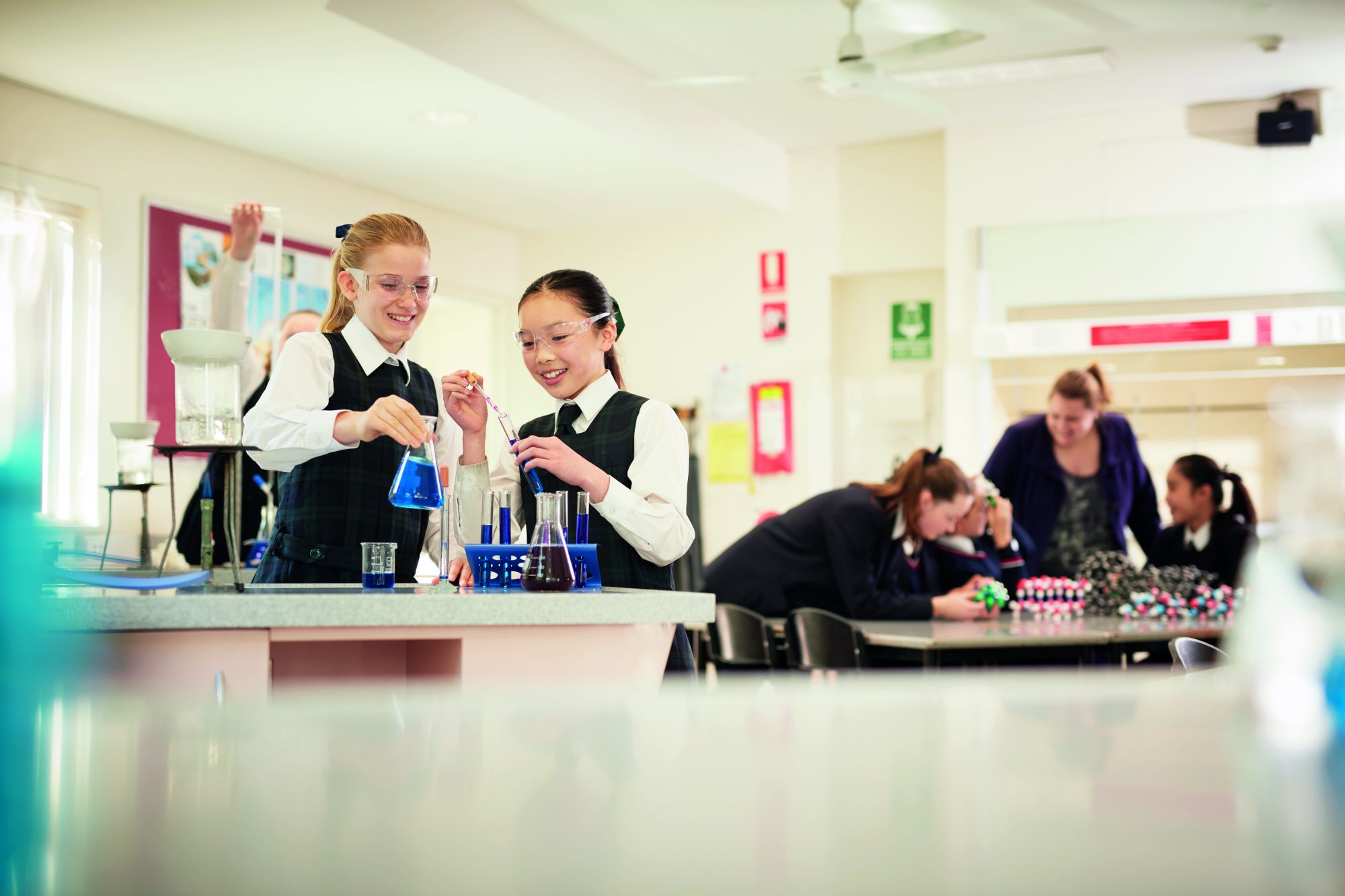
To understand how our wonderful teachers are fostering student agency, responsibility, scientific thinking and problem-solving, we are shining a light on Year 7 Science. Our Learning Leader Assessment and Differentiation and Science teacher, Mr Cedric Le Bescont, shares his ideas around the notion of our girls becoming apprentice scientists.
At Pymble, Year 7 students are encouraged to take responsibility for their learning by becoming apprentice scientists. In the Beyond Earth Project, they follow Tycho Brahe, Copernicus and Galileo’s footsteps to “explain that predictable phenomena on the Earth, including day and night, seasons and eclipses are caused by the relative positions of the Sun, the Earth and the Moon” (NESA, 2021).
“Whenever I ask myself simple questions, I end up learning more.”
As apprentice scientists, students develop strategies rather than simply collate explanations. What observable evidence can help me study day and night? How can I record the sunrise? Does the sunrise always occur at the same time? Apprentice scientists come up naturally with factual, conceptual and debatable questions. They look for facts, develop new skills and uncover evidence that transform the way they think about the world.
“Once we finished our data collection, we started finding patterns.”
Apprentice scientists learn to collect, record, visualise and analyse data to develop and test their understanding. Scientific knowledge resides in the relationship between patterns and models. From collecting to modelling, students are afforded the opportunity to use a broad range of tools. For data collection, they can choose to build a sundial or use interactive apps that simulate the position of the sun in the sky. For data visualisation and analysis, they can choose to construct a graph on paper or use their favourite spreadsheets.
To model the relative position of the celestial objects, they can choose to use a computer simulation of the solar system or real plasticine. In any case, the outcome is their own representation that describes, simplifies, clarifies and provides an explanation for their observations.
“I really enjoy learning in this way because there’s no perfect way in doing this and I can observe in any way I want.”
“When the work is difficult, I tell myself that in Science I should not be aiming for perfection and it’s all about exploring.”
Learning how to make Science, rather than describing Science, is like learning how to ski. It is a bit scary and even if the teacher is there to guide and keep everyone safe, each student must figure out what to do next to make progress. By taking ownership, they discover that Science is messy, uncertain, confusing and challenging, but at the same time much more rewarding than a Google search. The scientific method is arguably the most prolific learning process and mistakes are the strongest evidence of progress.
Science consists of a community of learners who share their findings and procedures. Apprentice scientists develop self-efficacy through social persuasion and vicarious experiences. Classes are designed for students to collaborate and regularly seek feedback. In doing so they develop multimodal communication and collaborative skills.
“When I face difficulties again, I think I would use the same methods (…), which include looking back at my data collection, exploring new tools and talking to peers.”
Science is not a fixed corpus of knowledge, but rather a specific way of learning that can be applied to a field of investigation as big as the universe. The knowledge produced by scientists can be trusted because they work rigorously to ensure the validity, accuracy and reliability of their work. After weeks of open-ended investigation, the assessment task is an opportunity to demonstrate rigor and clarity.
Students produce a short video to present a step-by-step method describing how they used different tools to collect data, a visualisation of their data as well as an explanation linking their data to a physical or simulated model. All students became true scientists in the sense that they have produced and shared knowledge to be reviewed.